If you picked an AI coding tool for your team earlier this year, that decision is probably already worth revisiting.
Releases are constant, benchmarks rarely capture what matters, and the lineup looks nothing like it did six months ago.
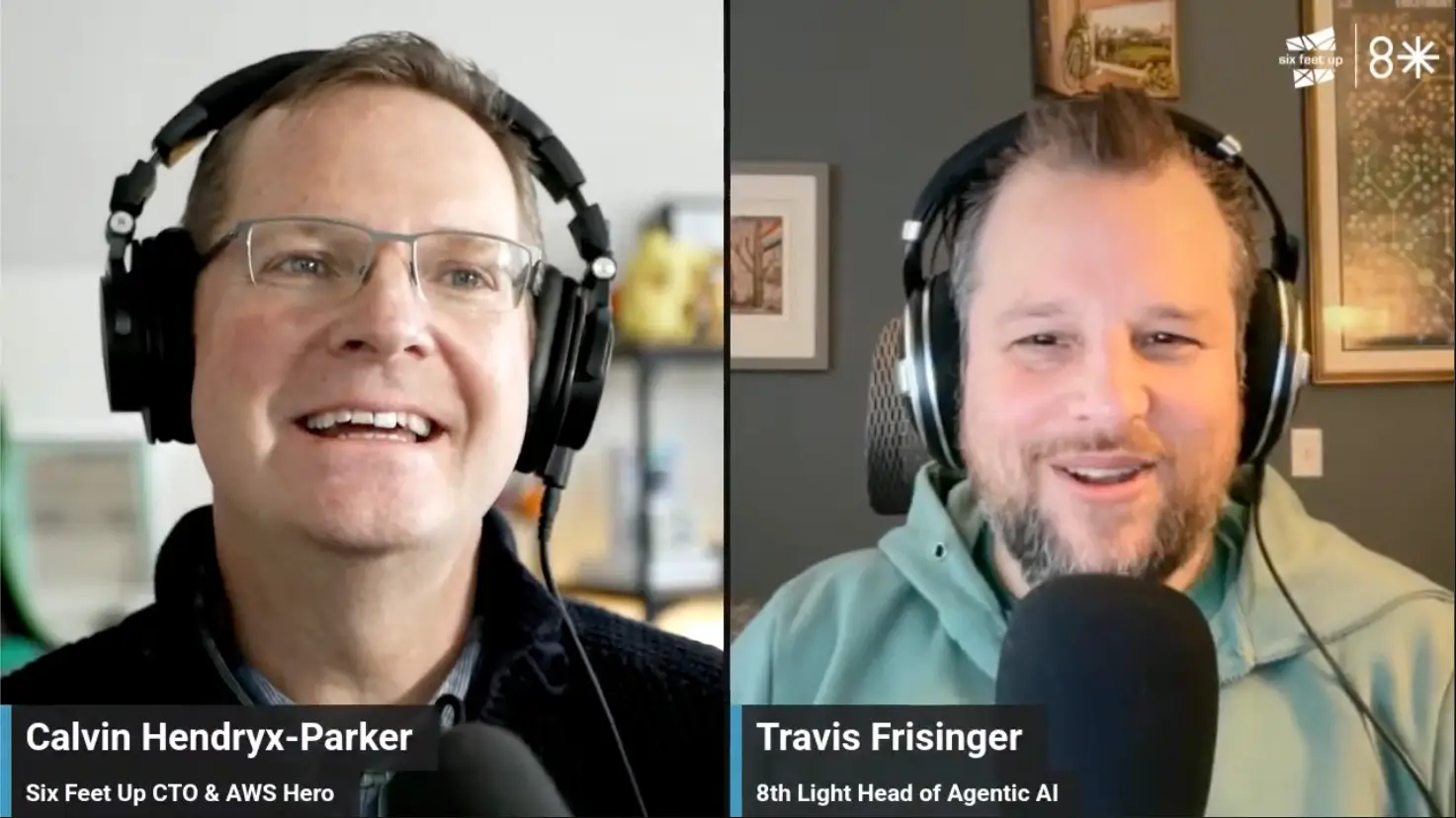
In the first round of Battle of the Bots, I teamed up with Travis Frisinger, 8th Light’s Technical Director of AI, to put five AI coding agents through their paces. Our verdict: no single winner, combine multiple agents, and treat them like well-educated interns.
That advice still holds. But the winning question has changed. It's no longer, “Which agent writes the best code?” It’s, “Which agent fits the way our team plans, reviews, governs, and ships software?”
4 Places AI Coding Agents Stumble
AI agents are landing in the middle of already-complex workflows. The wins are real, but only when the tools can handle the messy parts of software delivery: context, security, cost, and coordination.
The friction shows up in predictable ways:
Context drift. Agents lose focus when they are running in shared contexts, which is why sub-agent forking and stronger context management are becoming more important.
Security and governance. Sandboxing, policy controls, and enterprise guardrails aren’t optional, and every tool in this roundup knows it. Teams need to know what an agent can access, what it changed, and how those changes were reviewed.
Cost creep. Long-running agents and large repos burn tokens fast. The cost of experimentation can climb quickly without clear workflows and limits.
Multi-agent chaos. Parallel agents can accelerate delivery, but without clear ownership, review checkpoints, and audit trails, they create coordination debt fast.
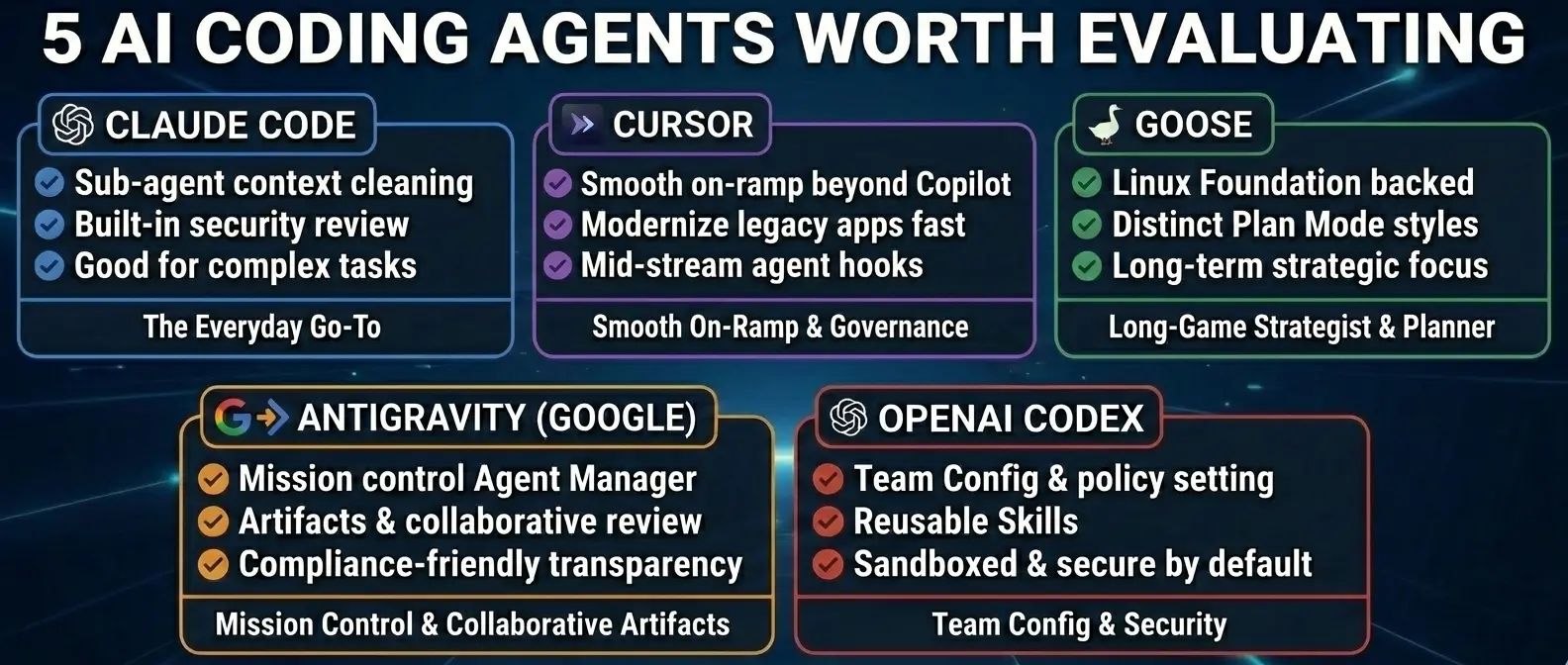
5 AI Coding Agents Worth Evaluating
Claude Code is the one we reach for first most days. Sub-agent forking keeps context clean when you're running complex tasks, and the built-in /security-review command, now with GitHub Actions integration, means teams are not cobbling together their own solution anymore. There are also multi-agent patterns worth exploring for more complex agentic workflows.
Cursor is still the smoothest on-ramp for teams moving beyond Copilot. Its Composer model can help teams quickly modernize legacy applications, including turning an older VB app into something modern enough to demo to stakeholders in under a week. The agent hooks let teams inspect and mediate execution mid-stream, redacting secrets and blocking commands. That’s the kind of control that helps security and governance teams get comfortable with agentic workflows.
Goose is playing a longer game than most. It joined the Linux Foundation's Agentic AI Foundation, the same model that turned Kubernetes from a Google project into an industry standard. The Plan Mode is also worth a look if keeping agents focused on task is a real pain point for your team. It offers distinct planning styles so teams can match the approach to the task.
Antigravity, from Google, takes a different approach with an Agent Manager that acts as mission control for running multiple agents in parallel. It also surfaces Artifacts (plans, screenshots, and browser recordings) that teams can review and comment on collaboratively. That matters more than you'd expect when you need to explain to a compliance team exactly what the agent did.
OpenAI Codex has come further faster than most people realize. Team Config gives IT a way to set baseline policies across repos while developers retain room to customize. Reusable Skills are also making repeatable workflows easier to package and share. Internet access is off by default in sandboxed environments, which matters for teams thinking seriously about risk. Multi-agent collaboration is also moving quickly, making Codex much more relevant than it was just a few months ago.
Raw Intelligence Isn't the Main Differentiator
Most of these tools are good enough at generating code, and we may be approaching a capability plateau on that front.
The real differentiators are planning workflows, multi-agent orchestration, context management, and enterprise visibility. The edge is less about raw intelligence and more about safe, repeatable execution inside real systems.
If you're locked into Copilot due to procurement or security constraints, you're not alone. Claude and Cursor are two tools worth making the case for internally. Lead with governance and visibility features, not just developer speed. And keep an eye on Codex; its enterprise controls are moving fast.
The tools are no longer the biggest barrier. Every team has access to something capable. What separates the fast movers from everyone else is the willingness to experiment, iterate, and build AI into how the work actually gets done.
The teams that win will not simply install an AI coding agent and hope for the best. They will define the workflows, guardrails, review patterns, and feedback loops that make agentic development safe enough to scale.
Watch Battle of the Bots 2.0: AI Agents Unleashed
Want to see the honest takes, surprises, and tools worth putting on your shortlist? Watch the full presentation and review the slides.
If your team is exploring AI in software delivery, let’s talk.