




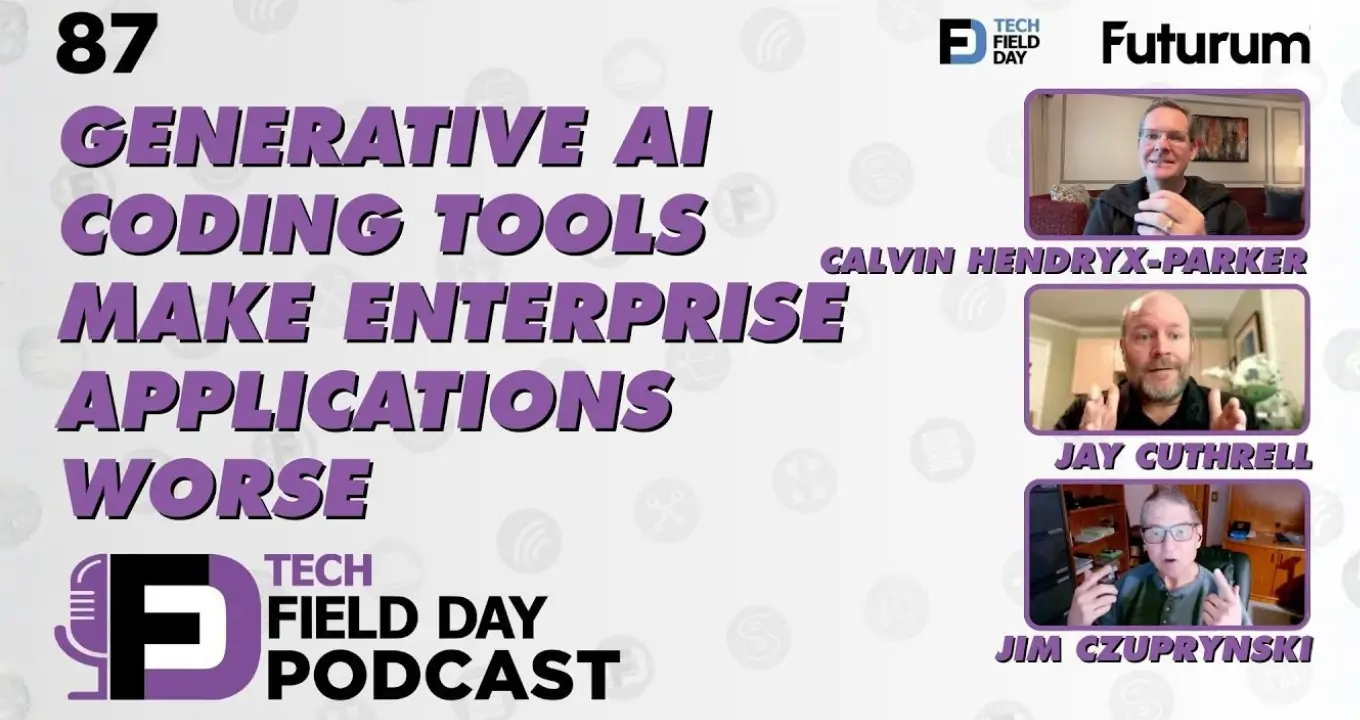
As much as 30% of Microsoft's code is AI-generated. Google and Amazon have made similar claims. The adoption has already happened, but we still don't trust AI.
That disconnect was at the center of a recent Tech Field Day podcast, “Generative AI Coding Tools Make Enterprise Applications Worse,” featuring a panel of AI experts and practitioners: Calvin Hendryx-Parker (Six Feet Up CTO and AWS Hero), Jim Czuprynski (Chief StoryTeller at Zero Defect Computing), and Jay Cuthrell (NexusTek Chief Product Officer).
They discussed where AI coding tools are proving useful, where they still fall short, and what enterprise teams may be underestimating as adoption accelerates.
Generative AI is especially effective in bounded modernization work: translating code from one language to another, upgrading frameworks, or moving legacy applications onto newer platforms. In those cases, the destination is relatively clear and the model has more patterns to draw from.
Greenfield enterprise development is different. New systems depend on institutional knowledge, undocumented decisions, and business-specific tradeoffs that models cannot reliably infer. As the panel noted, tool performance also varies widely by task. Some assistants generate application code quickly but struggle with the surrounding engineering work, like CI setup. Others handle the full picture.
The panel was direct: AI output quality depends heavily on who is driving it. Junior developers using these tools without guidance do not simply produce junior-level work; they produce less predictable outcomes.
In practice, that can mean code that appears to work in a quick test but introduces maintainability, reliability, or security issues later in production. A senior developer with AI tools isn't just safer; they're faster, more leveraged, and harder to replace than ever. The experience curve doesn't flatten. It shifts. Senior developers remain the critical variable.
If current coding assistants already require careful oversight, the next wave raises the stakes further. Agents that do not just write code but maintain, patch, and deploy it autonomously are coming fast.
The panel flagged a critical warning: within two days of Google releasing a coding agent, a data exfiltration vulnerability was discovered. The same capability that makes agentic tools powerful is their primary attack surface.
The panel offered practical guidance for teams moving in this direction:
The panel’s message was not that AI lacks potential. It was that enterprise teams need to be more intentional about where they use these tools, how they review the output, and what governance is required as the technology becomes more autonomous.
Read A CTO’s Guide to AI Coding Assistants for practical guidance on adopting assistants that ship faster, reduce risk, and refocus developers.
Six Feet Up, Inc.
11208 Windermere Blvd.
Fishers, IN 46037 - USA
Phone: +1 (317) 861-5948
Email: info@sixfeetup.com