




AI can deliver a convincing answer without ever reading all the information it was given. That's a serious problem when businesses rely on AI to analyze contracts, review documents, or inform decisions.
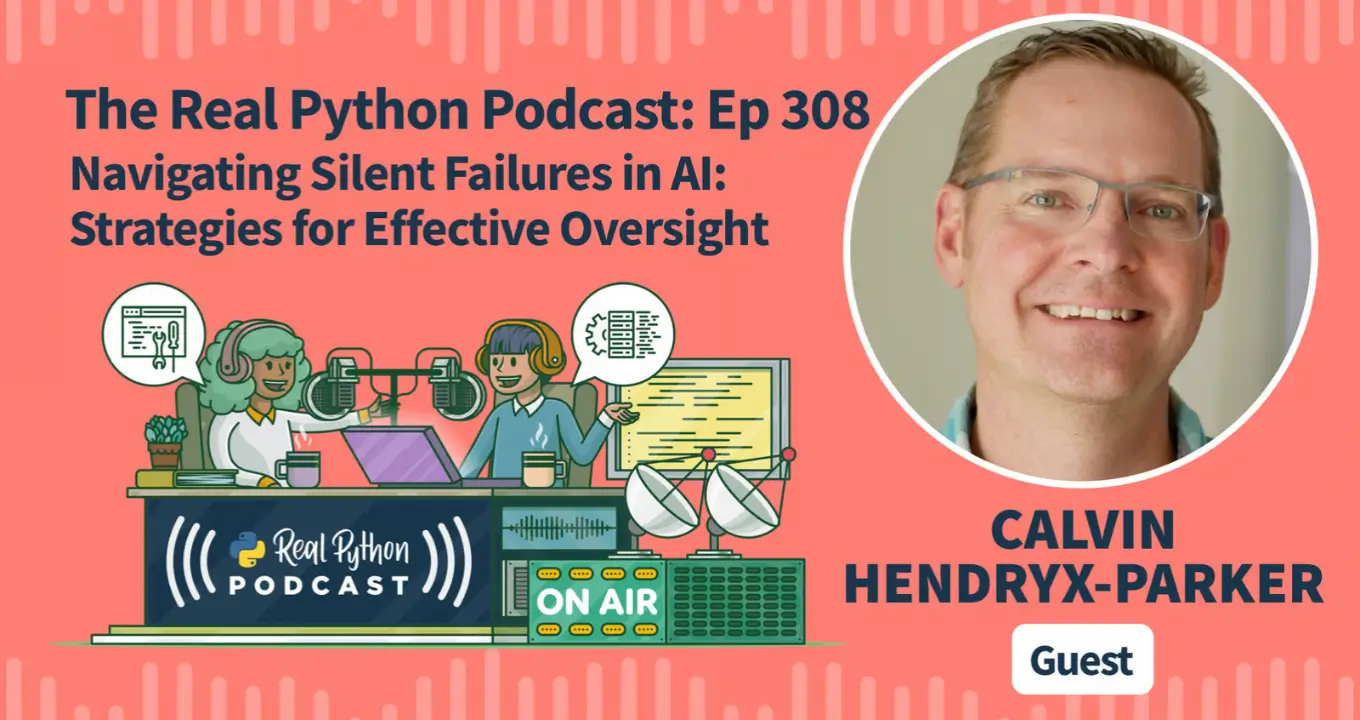
On episode 308 of the Real Python Podcast, Six Feet Up CTO and AWS Hero Calvin Hendryx-Parker joined host Christopher Bailey to discuss why AI fails silently and how to build more reliable systems.
Here are four practices that help teams catch errors before they affect decisions.
Calvin demonstrated the problem using a government RFP containing PDFs, Word documents, spreadsheets, and XML files.
When he uploaded the files to an LLM, it confidently answered questions while silently skipping approximately 436,000 tokens of information from a large XML file. The failure only surfaced when he explicitly asked what had been processed.
The lesson: A confident answer isn't proof of complete analysis. Verify that every required document was processed before trusting the results.
Larger context windows don't produce better answers. Too much information, including irrelevant documents, tool instructions, and conversation history, can make results less reliable.
Calvin recommends treating an AI's context window as a workspace, not a warehouse.
Instead of loading everything at once, use scripts to extract and organize documents, then retrieve only the relevant information for each task. Specialized subagents can work with smaller, cleaner contexts without carrying unnecessary information into subsequent steps.
AI workflows need more than a final answer. Teams should be able to see what happened along the way.
Calvin demonstrated a local workflow using Python, SQLite, ChromaDB, and agent hooks to track document processing and agent activity.
Audit logs record which agents performed which actions. Independent review agents can then check for missed information or questionable conclusions.
This gives teams a way to investigate results instead of relying on the AI's own assessment of its work.
AI models change, and an update can affect results even when the underlying workflow stays the same.
Calvin recommends using evaluations, or evals, to test AI outputs against known examples and expected results. These checks can run in continuous integration (CI) pipelines to detect unexpected changes.
The same software development lifecycle practices still apply: planning, implementation, verification, code review, and deployment.
AI is most useful when it strengthens human decision-making, not when it replaces oversight.
The goal isn't simply to get an answer faster. It's to know whether the source material was processed, the conclusions are supported, and the results can be reviewed.
An AI answer is only as reliable as the process behind it.
Real Python Podcast #308: Navigating Silent Failures in AI: Strategies for Effective Oversight
For a deeper technical walkthrough, read Why AI Fails Silently and How to Fix It, and explore Six Feet Up’s AI capabilities.
Six Feet Up, Inc.
11208 Windermere Blvd.
Fishers, IN 46037 - USA
Phone: +1 (317) 861-5948
Email: info@sixfeetup.com