




Many organizations treat GRC (Governance, Risk, and Compliance) like a compliance checklist. That may satisfy an auditor, but it leaves most of the value on the table.
Treating GRC this way is like putting a manual stoplight at every intersection of your operational grid. It slows everyone down and frustrates your engineering teams.
Instead, think of good governance as building a high-speed interchange.
When you design security controls early, something great happens: each one makes the next cheaper to build and easier to prove. Compliance becomes a natural byproduct of how you already operate, not a panicked fire drill the week before an audit.
The real inflection point happens when efficient GRC frees up operational capacity, shifting your posture from defensive risk management to fast, risk-informed decision-making.
The reverse is also true. Every year without a structured governance model adds risk debt. It compounds quietly in the background until it shows up as a breach, a failed audit, or a blocked enterprise deal. And nowhere is that debt piling up faster right now than with AI.
Gartner forecasts worldwide AI spending will reach $2.59 trillion in 2026, a 47% increase year over year. The pace of deployment is outrunning governance.
Unlike human employees, agents do not clock out. They can act continuously, at machine speed, across legal, HR, engineering, and customer-facing systems. If you grant agents broad access and try to figure out the guardrails later, you’re doing things backwards.
Not every AI use case needs heavy governance. But most organizations don’t overinvest in governance — they under-instrument risk.
Without data about what a system touches, who uses it, and how its behavior changes over time, “low-risk” is not an assessment. It is a guess. This matters most for FinOps and cybersecurity, where the cost of guessing wrong compounds quietly. You won’t find out you were wrong until the breach, the audit finding, or the runaway API bill arrives.
The solution is to instrument first. Let observed data determine the right level of governance before risk scales across teams, systems, and regulatory obligations. If your governance model isn't in place before AI scales, you won't be able to automate it. And if you can't automate it, you will lose control of your environment.
Most GRC friction stems from language ambiguity. First, you need clarity on what you are actually managing:
Operationally, compliance gets the most attention because it is the most tangible. There is an audit, a deadline, a checklist. But compliance without governance is just passing a test.
Governance is the piece many teams get wrong because it has its own internal vocabulary, and that vocabulary is rarely agreed on. When someone says “control,” do they mean a control objective, a benchmark, a standard, or a procedure? When business goals do not translate into technical reality, engineers are left to guess.
To move past passing the test, teams need a shared lexicon for governance itself.
Your organization may label things differently, and that's fine. What matters is that each term is well understood internally, and that together they are mutually exclusive and collectively exhaustive: every part of your GRC process maps to one term, with nothing left uncovered.
Here is how Six Feet Up’s lexicon flows, from strategic intent down to engineering execution:
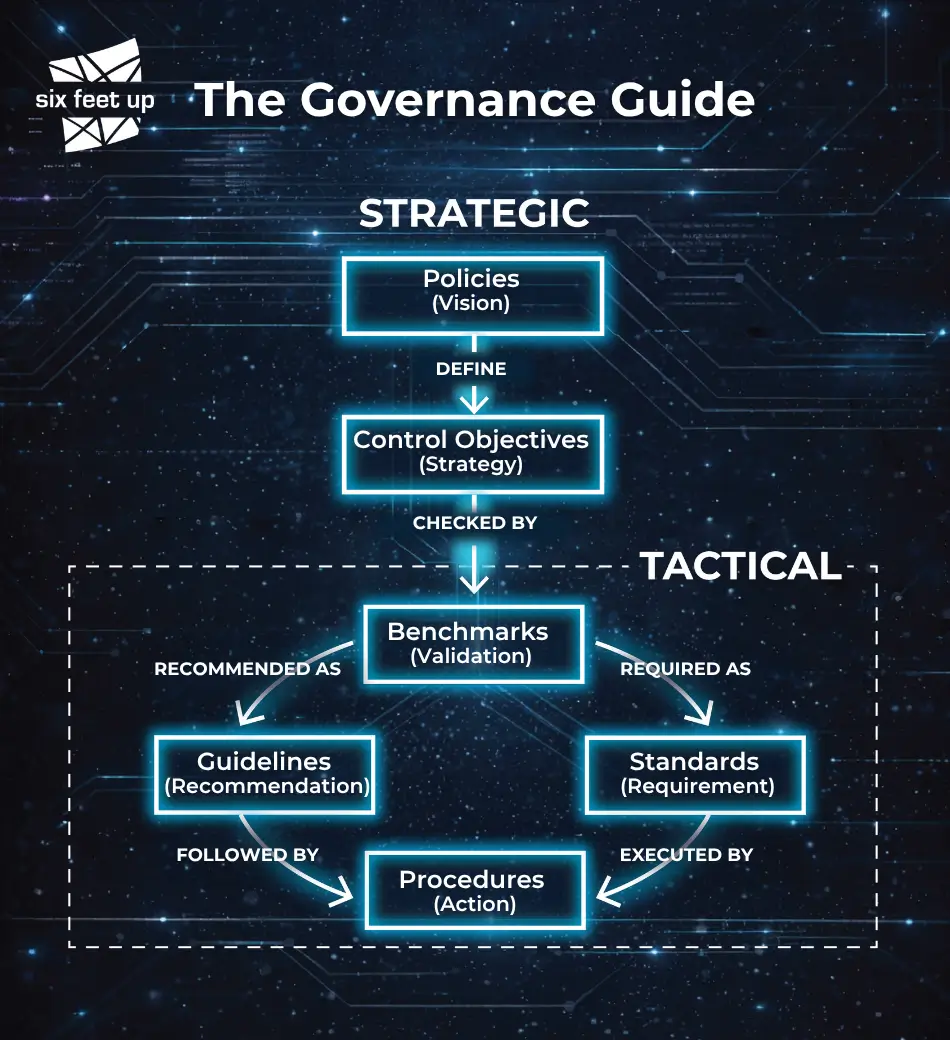
This clear, one-way direction makes your GRC model easy to explain to a board, practical for engineers to use, and simple to defend to an auditor.
When your GRC model is traceable, it behaves like an engineering system. A single policy can map to multiple compliance frameworks, procedures can be automated, and security gaps can be found before an attacker, auditor, or customer finds them.
In a recent AWS and Azure environment, overlapping compliance frameworks had made policy development slow and inconsistent. Once the directional model was in place, single policies could satisfy multiple frameworks, and coverage gaps became visible. Read more in "Scaling Cost and Compliance with Policy as Code."
Modern GRC should not slow teams down. Security is an enabler, not a blocker. That is what compounding looks like in practice: governance treated as part of the system, not the paperwork around it.
Six Feet Up, Inc.
11208 Windermere Blvd.
Fishers, IN 46037 - USA
Phone: +1 (317) 861-5948
Email: info@sixfeetup.com