


Stacklet serves organizations with massive cloud footprints. Their clients need tighter control over cloud spend and stronger compliance without dedicating large teams to writing and maintaining policy logic.
The company needed the ability to generate comprehensive, out-of-the-box Policy as Code (PaC) for AWS and Azure using Cloud Custodian (c7n), an open-source Python rules engine for cloud policy management.
In practice, several constraints made that difficult to scale:
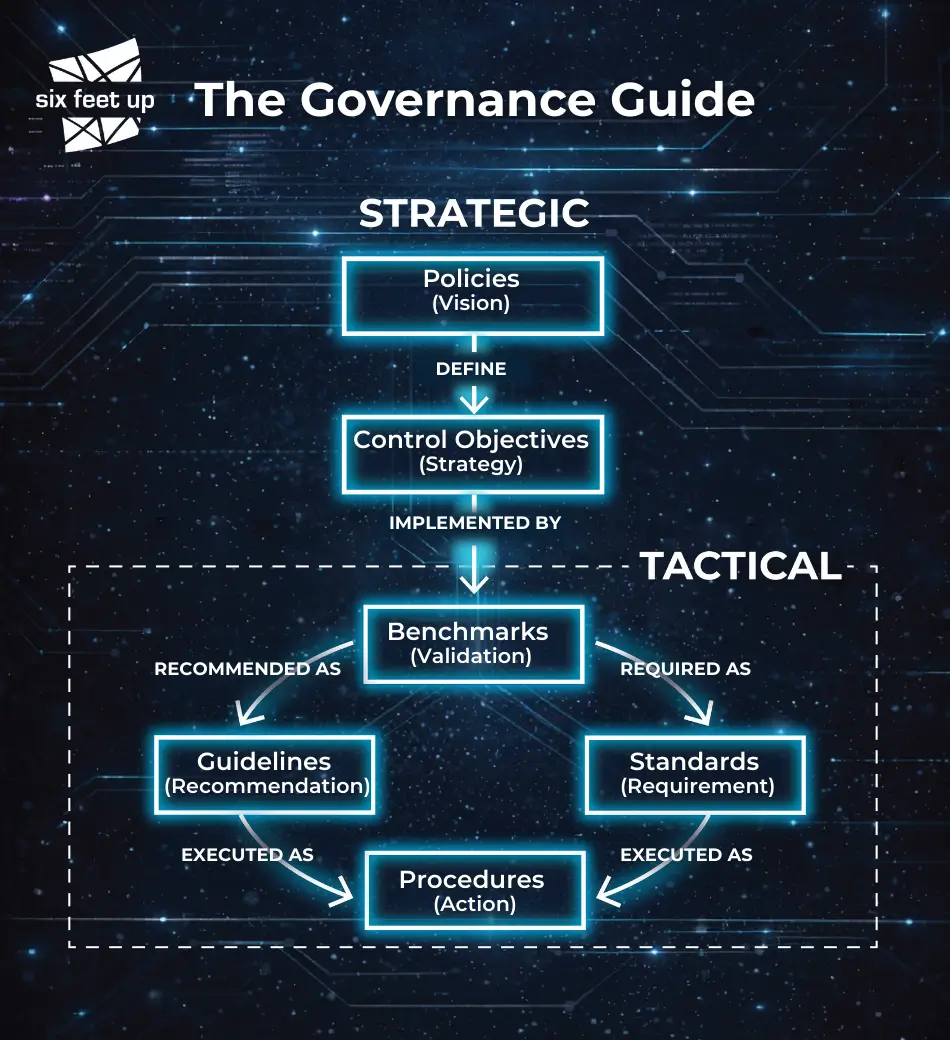
The Governance Guide:

Six Feet Up built a system that transforms vague compliance requirements into verified, production-ready policies that can evolve with changing frameworks and cloud platforms.
The first step was treating frameworks as structured data rather than flat documents. Using Python, Django, and SQLite, Six Feet Up designed a governance, risk, and compliance model that:
Once frameworks were expressed in this model, many control objectives that looked unique mapped to the same benchmarks. Overlap across frameworks became explicit and reusable, instead of being buried in documents.
Six Feet Up then built a crosswalk application that maps many control objectives to a single benchmark. Each benchmark is implemented as a Cloud Custodian policy in YAML, allowing a single policy to satisfy benchmarks across multiple frameworks and clouds.
This crosswalk:
With structured data in place, AI became practical. Six Feet Up evaluated several large language models (LLMs), with most use centered on Claude.
The team found that:
Engineers review the AI-generated YAML, make adjustments, and run it through automated tests using real infrastructure, defined as code using Terraform. LLMs also suggest concrete interpretations for ambiguous requirements, which the team can accept, reject, or refine.
AI is treated as an accelerator, not as an authority. The guardrails come from the data model and the tests, which is what keeps the focus on cost and compliance outcomes.
Policy definitions are only useful if they behave correctly in live environments, especially for rules that touch sensitive Azure and Entra ID resources.
To make verification repeatable, Six Feet Up designed a CI/CD workflow using infrastructure as code:
Highly sensitive tests run in dedicated infrastructure isolated from production accounts. This lets Stacklet ship or update policies with confidence that each change has been exercised against realistic, contained cloud environments.
As the crosswalk, a map from benchmarks to policies, filled out, it exposed benchmarks that mapped to resources Cloud Custodian didn't yet support. The team used these gaps to drive focused extensions to Cloud Custodian, adding new resource types with tests and documentation, then wiring them back into the crosswalk and testing loop.
Stacklet's Policy as Code capabilities grew in direct response to framework needs.

Policy development at Stacklet now runs as a repeatable, transparent system that grows cost and compliance coverage with Cloud Custodian across AWS and Azure. Controls that once required custom development now ship as part of the platform.
The governance model, crosswalk, and infrastructure as code tests give the team a single view of how frameworks, controls, benchmarks, and policies connect, and a safe way to validate behavior in realistic environments.
The system delivers:
Stacklet and Six Feet Up continue to evolve this system, adding framework coverage and extending Cloud Custodian's capabilities as new requirements emerge.
Struggling with how to automate tedious, repetitive and error-prone tasks at scale? Contact us.




Strengthening a Fast-Growing Social Platform
High-Growth Social Platform


Geospatial Analysis from 30 Minutes to Seconds
US-based Distribution Company
Six Feet Up, Inc.
11208 Windermere Blvd.
Fishers, IN 46037 - USA
Phone: +1 (317) 861-5948
Email: info@sixfeetup.com