



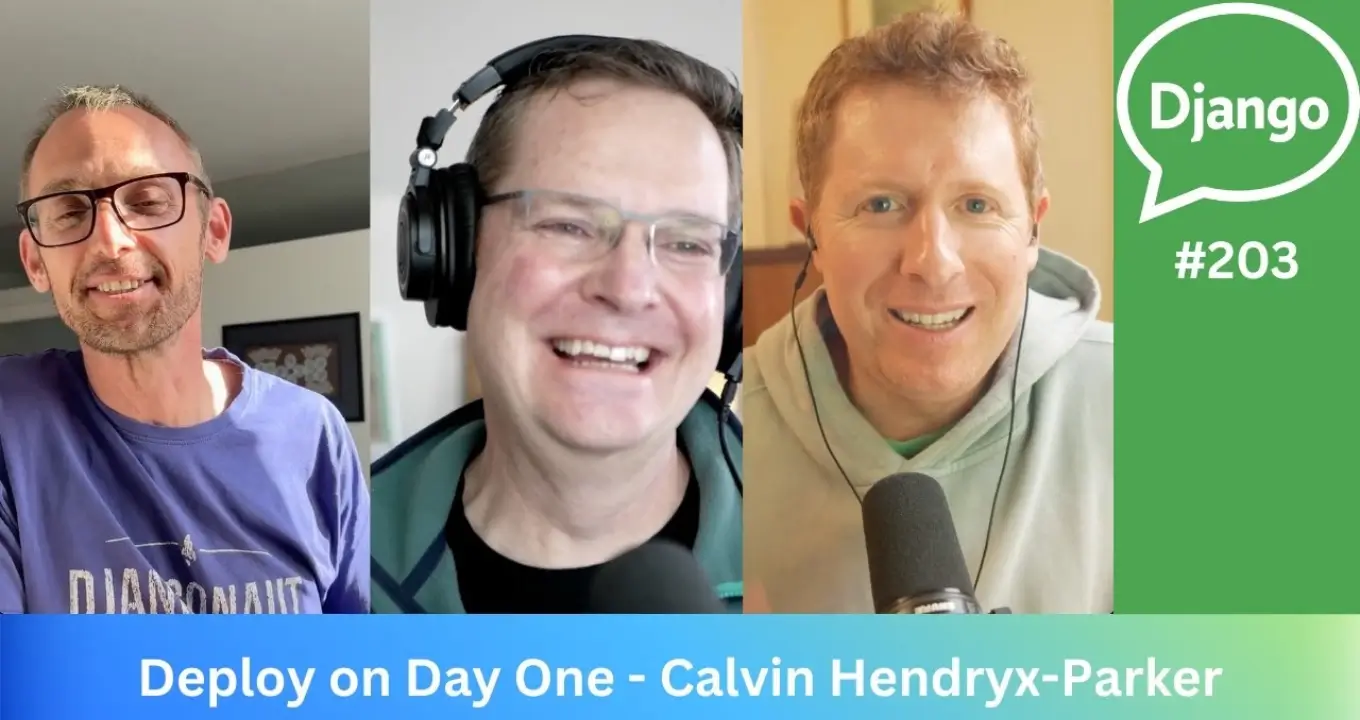
Deployment problems often begin long before production. Six Feet Up CTO and AWS Hero Calvin Hendryx-Parker explained how to head them off on episode 203 of Django Chat, “Deploy on Day One,” hosted by Will Vincent and Carlton Gibson.
His argument: developer setup, infrastructure, and deployment should work as one system, not three separate concerns. Here are three practices that make deployment predictable.
A new developer shouldn’t need days to reconstruct a project environment. A working local app shouldn't need a separate effort to become deployable.
That thinking shaped Scaf™, Six Feet Up’s open-source project bootstrap tool. Scaf combines tools including Django, Kubernetes, Copier, and Tilt to create a repeatable path from local development to production. Developers clone the project, start the services, and get to useful work.
Move setup and deployment steps into tooling, not tribal knowledge or manual checklists. Then keep local, staging, and production as close as you can. The fewer differences, the fewer surprises at release.
Some platforms look simple because they hide complexity. That works until your team needs more control and hits a proprietary limit.
Carlton compared Kubernetes to a jumbo jet when a small Django app might only need a light aircraft. Calvin acknowledged the tradeoff. A base Scaf deployment on AWS can cost more than $100 a month.
Calvin's case for Kubernetes: it's explicit, and that explicitness works as documentation you can run. Tools like Tilt and Argo CD automate tedious, error-prone steps, making infrastructure more predictable and easier to manage.
For more on when Kubernetes makes sense, read Everyday Kubernetes: It's Easier Than It Looks.
Before you commit to a platform, ask what you'll need to operate and change over time. Choose tools for long-term needs, not short-term novelty.
The conversation also covered AI-assisted development. AI can accelerate prototyping and help clarify requirements, but generating code quickly is different from building software that holds up in production.
Prototyping tools like Lovable and Replit can get you started fast, but architecture, security, deployment, maintainability, and what Calvin called "day two" operations still require experienced judgment.
Use AI to accelerate development, but keep experienced engineers responsible for architecture and operational decisions.
The real test of a deployment strategy isn't whether an application launches successfully. It's how easily the team can onboard new developers, ship changes, troubleshoot problems, and keep the system running six months later.
Calvin's goal for Scaf, getting a new developer productive within an hour, is one measure of that readiness. That's day one, done right.
Build for the next hundred deployments, not just the first one.
If you're deploying Django or Kubernetes, try Scaf for yourself.
Six Feet Up, Inc.
11208 Windermere Blvd.
Fishers, IN 46037 - USA
Phone: +1 (317) 861-5948
Email: info@sixfeetup.com