If you’re exploring IoT or hardware-enabled features, the biggest risk is rarely the hardware. It’s how long it takes to prove the concept is worth building.
Traditional embedded development often means specialized skill sets, vendor tooling, and slow iteration cycles. That can turn early discovery into a months-long investment before you get meaningful customer feedback.
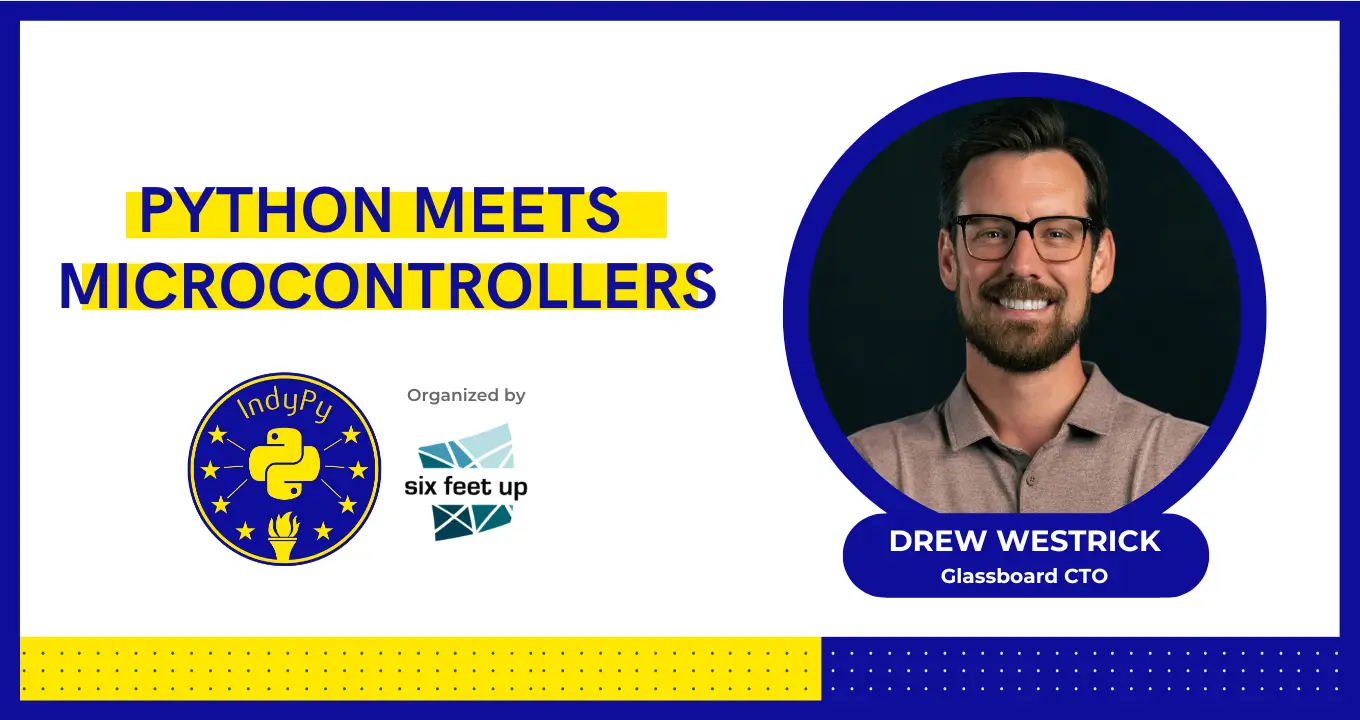
At the January 2026 IndyPy, Drew Westrick (CTO and co-founder of Glassboard) shared how MicroPython can shorten that cycle by letting Python-fluent teams build believable prototypes on inexpensive boards, learn faster, and make a better "build vs. pivot" decision sooner.
Takeaways
Prototype with the Python team you already have.
Your Python developers can prototype hardware sooner than you think. MicroPython runs on popular microcontroller boards and supports a REPL-first workflow, so teams can interact with sensors, Wi-Fi, and Bluetooth in real time with familiar Python syntax. No C, no vendor toolchains, no weeks of ramp-up. Plus, you get library management via mip (think pip for microcontrollers).
Iteration speed changes the economics.
When updates land in seconds, the cost of learning drops fast. Drew demonstrated three working prototypes live: a Wi-Fi weather monitor, a Bluetooth sensor readable from any smartphone, and a diabetes management display pulling live glucose data. Each took hours to build, not weeks. The point wasn’t the novelty. It was how quickly you can get to “demoable” hardware behavior.
Validate before you commit.
For product and technology leaders, the real value is answering three questions earlier and cheaper: Will customers use this? Does the hardware experience work? Should we build this feature? MicroPython helps you get real signals before making expensive platform and staffing decisions.
Address production tradeoffs head-on.
Drew doesn't gloss over the limits. He covers when MicroPython is the right tool and when you'll want Zephyr, an RTOS, or bare metal instead. He also discusses practical concerns like repeatable builds, dependency management, and OTA update patterns.
If your team knows Python, the barrier to testing hardware ideas is lower than you think.