



A developer gets temporary permissions to fix an issue. A service account outlives the project it was built for. An access key goes 90 days without rotation. A role gets an "allow all" grant because something needed to work right now.
Individually, these decisions may be reasonable. The risk comes when temporary access becomes permanent.
That is how Identity and Access Management (IAM) drift develops: access gradually moves away from what your organization intended. As infrastructure changes and exceptions accumulate, the attack surface grows with it.
IAM drift often shows up during an audit, an incident, or an investigation into access that should have been removed months earlier.
Four areas deserve consistent attention:
Point-in-time reviews only show what was true when they ran.
Cloud environments keep changing. People move between teams, applications are retired, infrastructure is rebuilt, and permissions are added for immediate needs.
That gap creates both security and operational risk.
Automating every remediation on day one tends to cause more problems than it solves. False positives create disruption. Too many alerts create noise. Poorly tuned policies can break legitimate workflows.
A better approach is to move through five stages: detect, notify, tune, remediate, automate.
Start by detecting the issue and confirming the signal is accurate. Notify the right people and tune the policy based on what you learn. Once the team trusts the results, move into remediation and, where it makes sense, automation.
Security can define the policy, but engineering is where those controls live.
Permissions are part of deployment pipelines, service accounts, infrastructure code, and application architecture.
Catching drift early and fixing it quickly matters more than passing any single audit.
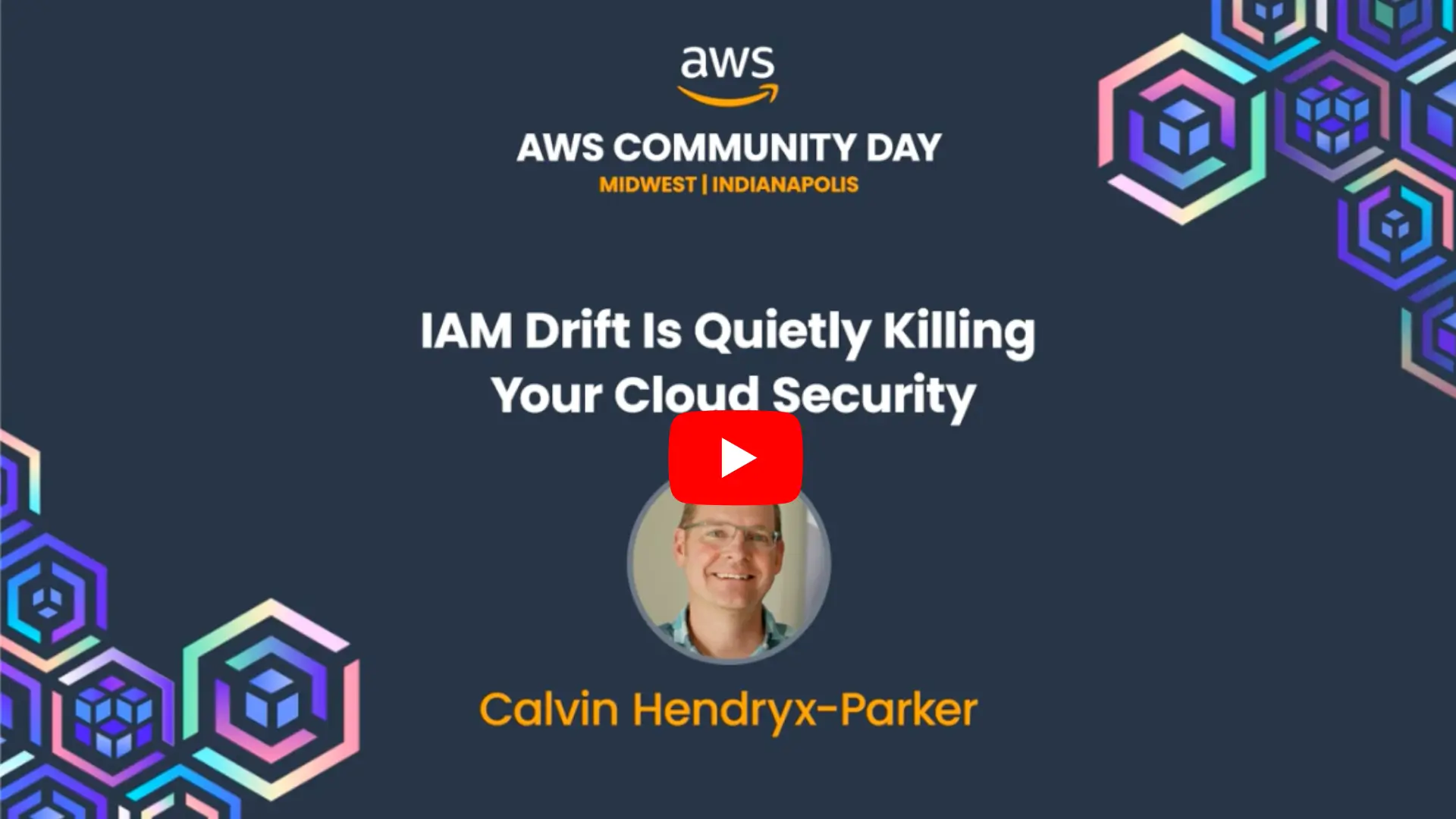
In the full talk from AWS Community Day Midwest 2026, I walk through how to apply this model using Cloud Custodian, an open source Policy as Code tool, with practical IAM examples across AWS, Azure, and GCP.
If you’re seeing IAM drift in your environment, start with detection. Six Feet Up can help you use Policy as Code to find issues, tune the controls, and automate remediation once you trust the results. Contact us.
Six Feet Up, Inc.
11208 Windermere Blvd.
Fishers, IN 46037 - USA
Phone: +1 (317) 861-5948
Email: info@sixfeetup.com