


Teams evaluating AI reliability often start by comparing models, benchmarks, and vendors. Those choices matter, but they don't answer the question that matters most in production: can you trust the system around the model?
Large language models (LLMs) are stochastic by design. Their outputs follow patterns, but the exact result isn't predictable until it happens. That variability is inherent to how these systems work.
For an RFP, contract review, compliance workflow, or other business-critical process, reliability has to come from the architecture around the model.
Picture a common scenario. Your team hands an AI system a 12-megabyte RFP package: addendums, forms, spreadsheets, the full bundle from a state procurement office. You ask it to identify red flags, IP concerns, and anything worth a second look.
The model returns a detailed, confident analysis.
What it doesn't mention: one of the embedded files was 339,000 tokens. The context window maxed out at 200,000. That file was never read.
The model said nothing about it.
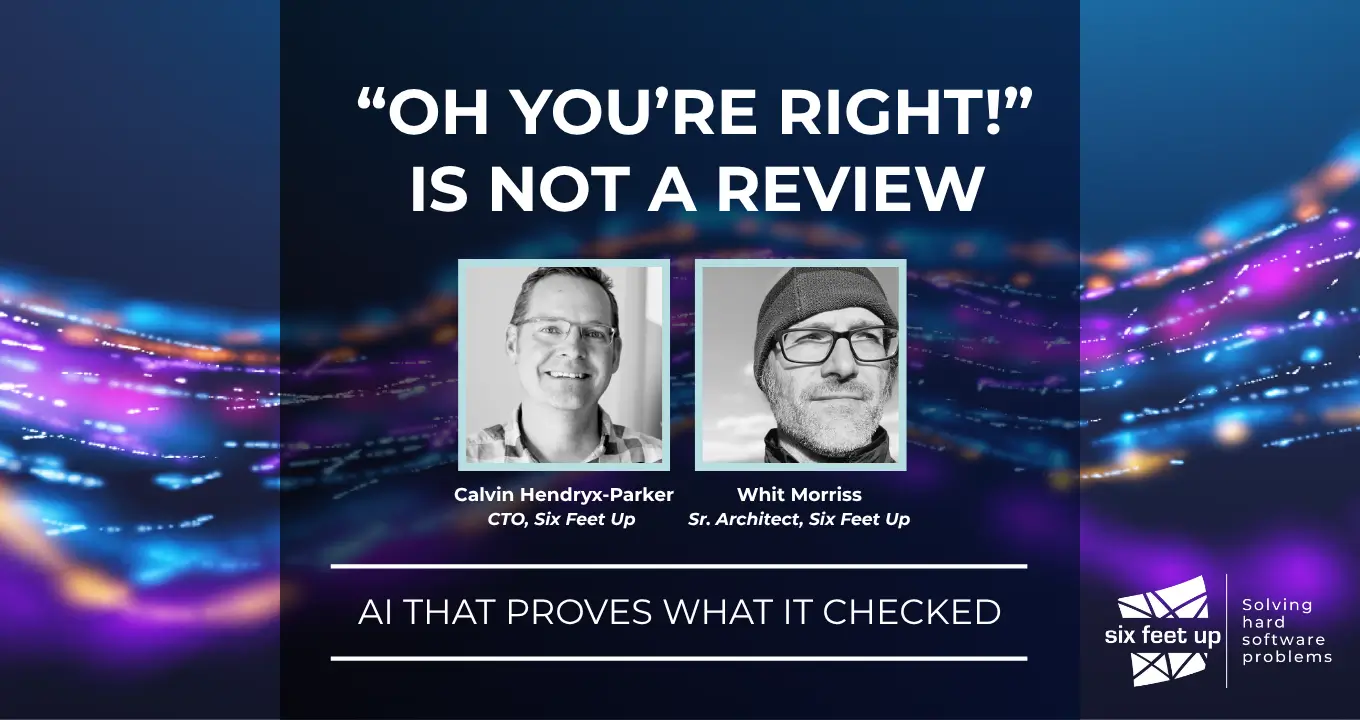
When AI misses the clause that actually matters, you point it out, and the model replies, “Oh, you’re right.” That’s not a review. That’s a liability. The bigger concern is the mistake you never catch.
You need a way to prove what the system actually evaluated.
As context gets overloaded, important information can fall outside the limit, recent material can pull the model's attention away from earlier content, and failures can become harder to spot.
It also gets more expensive. System prompts, tools, MCP servers, conversation history, and documents all consume context before the model starts solving the problem.
Reliable AI workflows separate deterministic processing from model-driven reasoning.
In our LinkedIn Live demo, Python handled the repeatable work: loading documents, breaking them into consistent chunks, storing them in a searchable database, and logging each step. Specialized agents then retrieved only the context needed for reasoning, evaluation, and review.
An orchestrator coordinated the workflow, keeping each agent focused on its task.
On the same 12-megabyte RFP, the workflow used just 38,000 tokens in the main context window, reducing inference costs while improving traceability and troubleshooting.
For any AI workflow touching business-critical decisions, ask:
If you can’t answer those questions, you don’t yet have a reliable production system.
All demo assets, agent definitions, the Claude Cowork plugin, and slides from this talk are available in this GitHub repository.
Ready to build AI your team can trust? Explore Six Feet Up’s AI capabilities.
Six Feet Up, Inc.
11208 Windermere Blvd.
Fishers, IN 46037 - USA
Phone: +1 (317) 861-5948
Email: info@sixfeetup.com